Signals, Trends, Megatrends: How to Tell the Difference
Weak signals, signals, trends, drivers and megatrends. Why the discussion about what a phenomenon could mean is worth more than the label you land on.

Photo by Alfred Schrock on Unsplash
A few weeks ago I had an exchange with someone who had been through our Foresight Facilitator training and now teaches futures himself. He was building a teaching tool: a simple matrix for helping students place a phenomenon somewhere between signal, trend and megatrend. He sent over three versions and asked what I thought.
What I liked immediately was the intention behind it. He was using the matrix less as a taxonomy and more as a way to get people discussing where a phenomenon sits and why. That is a far more useful exercise than memorising definitions, and it is much closer to how the distinction behaves in practice than to how it usually gets taught.
It also prompted me to finally write down something I have been circling for years. Anyone who works with futures gets asked the question sooner or later, usually by a client halfway through a workshop: so what is the actual difference between a trend and a megatrend? And the honest answer is that it depends who you ask, which is an unsatisfying thing to say to a room of people who have just been handed a stack of post-its.
Why the terminology is so inconsistent
Part of the problem is historical. The term megatrend was coined by John Naisbitt in 1982, popularising a concept the military strategist and futurist Herman Kahn had explored in the 1970s. Since then it has been picked up by consultancies, institutes, government units and marketing departments, each of which had a reason to define it slightly differently. Weak signals and wild cards arrived through a separate lineage in futures research and horizon scanning. Drivers came in from scenario planning. None of these vocabularies were designed to fit together, and yet we now use them in the same sentence.
The result is that the field carries several competing definitions and uses of the same handful of words, and practitioners switch between them without often taking the time to define them out loud. That is workable for those of us who do this daily but confusing for the people we are trying to help.
So when I teach or facilitate, I try to simplify instead of adding terminology. The categories are useful when they help a group see structure in what they are observing. They stop being useful the moment the group starts arguing about the labels instead of the change.
The (loose) hierarchy we work with
I tend to use a short ladder: weak signal → signal → trend → megatrend
An example could be: bundled living options → Spain's Digital Nomad Visa → war for talent → Liquid Lifestyles
Before the definitions, one caveat that matters more than any of them. A hierarchy like this is a fiction. There is no clear dividing line between the layers, in the same way that there is no principled point at which a settlement on a map becomes a village, a town or a city. It is decided by criteria we have agreed to find useful. Saying that out loud, instead of presenting a hierarchy as a discovered structure of reality, changes how a group uses it.
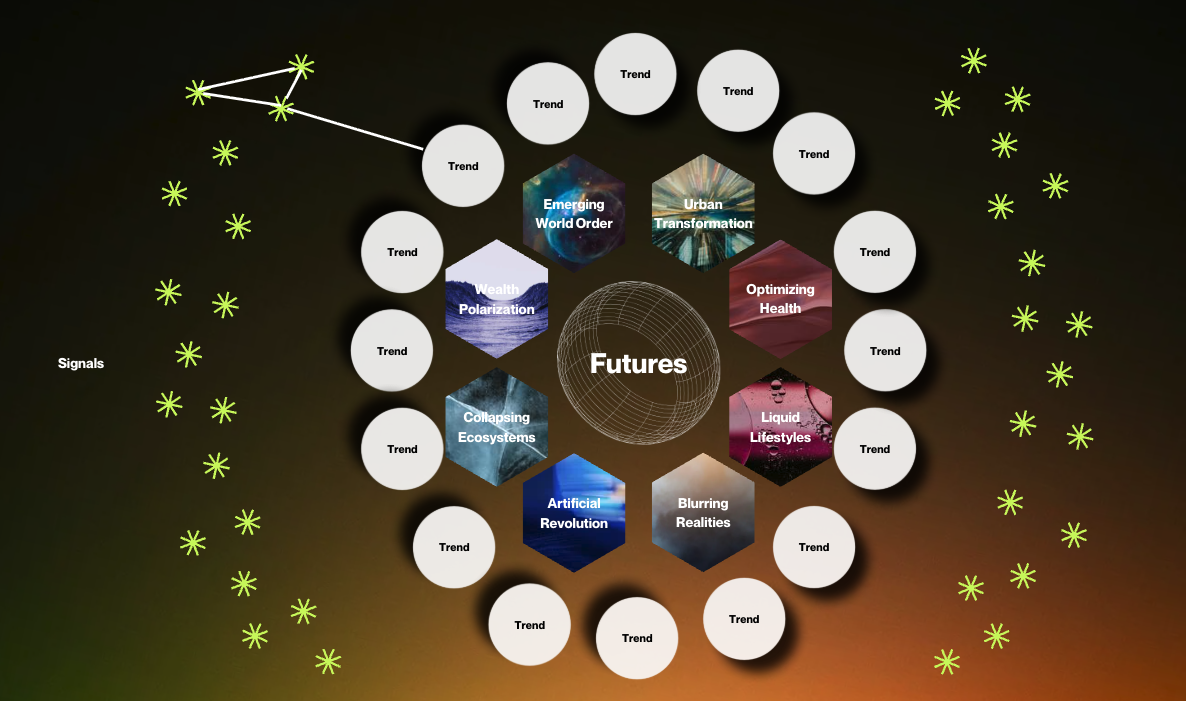
A model of how we work with different dynamics of change. ANTICIPATE, 2026
Weak signals
Weak signals are early, low-visibility indications that something may be changing. They are unusual or surprising pieces of information that do not fit existing expectations, and their significance is not yet clear. The classic description in the futures literature is that searching for weak signals means looking for something without knowing what you are looking for.
An example I have used is the appearance of bundled living options: housing offered as a subscription-style package with services attached, in places where that model has no established market. It may amount to nothing. It may also be the first visible edge of something structural.
Signals
Signals are observations of change: something concrete that has happened, that can be dated, sourced and pointed at. A policy, a product launch, a court ruling, a funding round, a clear shift in behaviour. Spain's Digital Nomad Visa qualifies because it exists, it can be cited, and it tells you something about how states are beginning to compete for mobile labour.
The part worth spelling out is that an event only becomes a signal when someone frames it as pointing somewhere. Raw news is not a signal. It becomes one at the moment a person says this might mean something beyond itself. That framing is an act of interpretation, which is why two people scanning the same week of headlines will come back with different collections, and why signal work is a skill rather than a clipping service.
Some criteria I find useful when judging whether something is worth keeping:
Concrete. It happened, in a place, on a date, with a source behind it. If you cannot cite it, it is an impression.
Transferable. It says something beyond its own context. The Spanish visa scheme is interesting for what it implies about the future of national borders and labour, and much less interesting as a fact about Spanish immigration policy.
Disconfirming. The best signals unsettle an assumption someone in the room holds, even if only a little, and that is why the margins and edges of society are such a good place to look. A signal that confirms what everyone already believes has low information value even if it is perfectly true.
Novel enough to be uncomfortable. If nobody in the room reacts, you have collected a fact and missed a signal. We are after the small aha-moment.
The boundary between a weak signal and a signal is about visibility and recognition, and it says nothing about importance. A weak signal is one where the evidence is thin, the interpretation is contested and the significance is more or less unclear. Promoting something up a rung is a statement about how much evidence has accumulated. Some of the most consequential things start as weak signals, and some weak signals stay weak forever. In practice we often skip the labelling step entirely, because the distinction rarely changes what a group does next.
The common failure mode is that signal collection becomes volume. Signals are cheap to collect and much harder to make sense of, so you end up with three hundred cards and no shared understanding of any of them. The discipline that fixes this is forcing every signal through what, so what, now what before it is allowed into the collection. If nobody can articulate the so what, it stays out.
Trends
Trends are patterns or directions of change formed by many signals over time. The war for talent is a trend. No single hiring statistic constitutes it; the accumulation of many of them does.
This is where most of the argument lives, and I think there are four separate confusions stacked on top of each other.
First, the word does double duty. In everyday and commercial use, a trend is a fashion: short-lived, cyclical, something that is trending. In foresight it means close to the opposite, a sustained directional change observable over years. Same word, incompatible time horizons. When a client says "that's just a trend", they usually mean it will pass. When we say it, we mean it will continue.
Second, a trend is a claim more than a stable object. A trend does not exist independently of someone deciding that a set of signals belongs together and points the same way. The war for talent is not out there in the world waiting to be found. It is an interpretation imposed on a large number of separate observations about hiring, wages, mobility and demography, which means every trend statement carries an implicit argument about grouping, and that argument can be wrong. Two competent analysts can look at the same signals and draw the boundary in different places.
Third, naming something a trend smuggles in a forecast. A pattern in past data is a description. Calling it a trend adds an assumption that the direction will hold, at least for a while, and that assumption is doing enormous work while almost never being made explicit. It is worth asking of any trend: what would have to happen for this to plateau, reverse or split into two? Trends bend, and there is always uncertainty about the direction they will take next. They also generate counter-trends, and a mature trend statement usually has its own reaction visible inside it. Increasing digitalisation of everyday life and the return of deliberately analogue practices are the same story told from two directions.
Fourth, the boundaries in both directions are unstable.
Trend against driver. A trend describes what is happening; a driver describes why. But the same phenomenon flips depending on where you sit. Remote work is a driver if you are looking at housing markets and a trend if you are sitting in HR, and the classification typically tells you more about the observer's position than about the phenomenon.
Trend against megatrend. There is no specific threshold. No number of countries, no number of years, no impact score. Some practitioners handle this by inserting a middle layer called key trends or sub-trends, the narrower developments that aggregate into a megatrend. That is an honest solution and it still rests on judgement, and it demonstrates the problem neatly: you can always add another layer, and each new layer needs its own boundary.
Trend against signal. Scale-relative, really. A development that constitutes a full trend inside one sector may register as a single signal at the level of society.
The practical rule I use for when a set of signals has become a trend: when you would be surprised if the next confirming observation did not arrive. It is unscientific and it works, because it makes the group state their expectation instead of counting their evidence. This is the point where sensemaking stops being a procedure and starts being a craft.
Megatrends
Megatrends are deep, long-running shifts that reshape multiple systems structurally. Liquid Lifestyles, one of the eight ANTICIPATE Megatrends, is an example: the gradual dissolution of traditional life paths as people rethink work, family, identity and consumption. It shows up in labour markets, housing, education, health and consumer behaviour at the same time, and it has been unfolding for decades.
The classical foresight literature distinguishes megatrends from other trends along three dimensions, and I still find them the clearest formulation available:
Time horizon. Megatrends are observable across decades, not years.
Reach. They affect all regions and produce multidimensional transformation across politics, society and economy. The impacts do vary considerably across geographies and sectors, which is why translating a megatrend into a specific context is the critical step.
Intensity of impact. They act powerfully on governments, individuals and organisations alike.
What those three dimensions leave out is everything you learn by actually building a set of them.
The selection criterion that matters most is trajectory. For a megatrend to be usable it needs a discernible direction of travel. Some of that is quantifiable, as with population growth. Much of it is not, and rests on qualified assessment of the underlying trends. Being clear about which kind you are presenting matters a great deal the moment a client asks to see the data.
They do not unfold in a straight line. Globalisation is the standard illustration: unmistakably upward across the long view, and repeatedly slowed or reversed by wars, embargoes, isolationism and trade disputes. A megatrend is a claim about the long shape of something, and it is fully compatible with a decade that runs the other way. This is the caveat clients most need and least want.
They are claims about the aggregate, and local reality can contradict them. Population growth is a global megatrend while Germany faces significant decline over the same period. Neither statement is wrong. If you are advising a German organisation, the megatrend is simply the wrong resolution to be working at, and the useful move is to descend a layer.
They are interconnected, which is both a feature and a hazard. Pulling one thread changes the tapestry, so the interaction effects are often where the strategic insight sits. It also means any clean list of separate megatrends is misrepresenting how they behave.
And the honest limitation: a megatrend list is a vantage point and a discussion tool, and it is not objective proof of anything. Most published lists cover much the same territory, so no advantage comes from possessing one. The value is entirely in the translation into a specific context, which is precisely the gap the Megatrends PRISM was built to close.
The ones that sit outside the ladder
There are many terms that get used alongside the ladder without belonging to it directly, and I find it clearer to say so than to force them into sequence. Three of them are:
Drivers are the underlying forces that cause change: the why behind the pattern. Remote work is a driver behind a good deal of what we currently observe in labour markets, housing, urban development and migration policy. Drivers arguably do not belong in this list at all. Weak signals, signals, trends and megatrends are all points on a spectrum of visibility and scale, whereas a driver (sometimes called driving forces) is a causal explanation. It sits across the ladder instead of on it, which is why I introduce it separately and only when a group is ready for causal thinking.
Macrotrends I use occasionally for extremely long-running structural developments such as demographic shifts or long-run economic growth, which stretch across fifty to a hundred years or more.
Wild cards are high-impact events considered too unlikely or too incredible to happen, which nonetheless sometimes do (see Covid-19 and other black swans). They are not a stage of anything but a different category of futures object altogether, and the useful test for one is social, not analytical: it makes people laugh, or makes them uncomfortable, or they insist it will never happen.
What actually separates them?
This is where I disagreed, gently, with the matrix I was sent. Its horizontal axis ran from global to local, and my instinct is that scale alone does not distinguish a signal from a trend or a megatrend. A signal can be global. A megatrend manifests very locally. Something can be observed in one city and be an early instance of a worldwide shift.
I think three parameters do most of the work, and they are more useful as reflection questions than as axes.
1. Scale and impact. How broadly does this phenomenon manifest, and how many systems does it touch? This is closer to what we mean by a megatrend than geography is. The question is whether the effects are currently contained, or whether they are propagating across sectors, geographies and domains at once.
2. Visibility and evidence. How much evidence or recognition exists today? This is the axis that most cleanly separates a weak signal from a trend. It is also the most honest one, because it describes the state of our knowledge instead of pretending to describe the state of the world.
3. Novelty. Is this actually new, or is it an acceleration or reconfiguration of something older? Weak signals typically carry a higher degree of novelty. Trends and megatrends are usually developments that have become established and visible over time.
Novelty is the parameter I find most interesting and most treacherous, because it is heavily subjective. What feels new depends on the observer, their context, and the assumptions they arrived with. A development can look completely unprecedented from one vantage point while being a straightforward continuation of an old pattern from another. That subjectivity is worth keeping, and engineering it out would remove the most valuable thing about the exercise, which is that it exposes what a particular group takes for granted.
Alongside these, timespan and trajectory are worth acknowledging even if they never become an axis. As a rule of thumb, megatrends unfold over a much longer trajectory, whereas a signal can be something we only started observing last month. Using trajectory as an additional lens tends to settle arguments faster than adding another dimension to the grid.
What building megatrends twice taught me
I have now been part of two megatrend development processes, and they taught me more about this question than any amount of reading.
The first was during my time at the Copenhagen Institute for Futures Studies, where I took part in the development of the fifteen global megatrends published in 2021. That process began with a longlist of well over a hundred lesser trends, which were merged and regrouped repeatedly until fifteen remained. Many candidate groupings were discussed and rejected along the way.
The second was our own process at ANTICIPATE, where we worked through the same problem from scratch and arrived at eight: Emerging World Order, Urban Transformation, Optimizing Health, Liquid Lifestyles, Blurring Realities, Artificial Revolution, Collapsing Ecosystems and Wealth Polarization.
Fifteen and eight. The European Commission's Megatrends Hub operates with fourteen, ungrouped. None of these is necessarily more ‘correct’ than the others.
That is the part I wish more people took from megatrend work. A megatrend is an aggregate, and the aggregation is a design decision. It draws a boundary around a cluster of trends that point in roughly the same direction while not being wholly parallel, and choosing where to cut produces different sets of different sizes. There are many ways to slice a cake. What you gain from the exercise is a shared, manageable model of the world, bought at the deliberate cost of some accuracy. A roadmap is less accurate than a satellite photograph and considerably easier to navigate by.
Sitting in those rooms is what convinced me that the boundaries between these categories are arguments, not facts. Which is exactly why a teaching tool built to provoke the argument is better than one built to settle it.
What the categories are actually for
All of which is why I prefer to keep matrices like the one I was sent as discussion aids rather than classification systems. The interesting conversation is rarely “is this a signal or a trend?” It is much closer to: why do we perceive this as new, how much evidence do we actually have, and what would make us update our view?
The models that try to organise all of this tend to arrive at the same underlying insight, and it is the one worth carrying away. Each type of futures knowledge implies a different kind of work.
The wild and the improbable call for free imagination. The early and low-visibility call for scanning and vigilance. Several plausible directions call for building alternatives. Long-running structural change calls for understanding the larger picture and the path dependencies inside it.
What separates these is not really how true each type of knowledge is, but how much of it rests on evidence from the past and how much on disciplined invention.