Foresight can be uncomfortable in many ways and that’s part of the design. But how do you tell when resistance show up, and how to deal with it and the different types of people in the process?

Photo by Tobi Oluremi on Unsplash
There is a particular quality of silence that arrives about forty minutes into a foresight workshop. The signals are on the wall, the sensemaking has started, and someone has just asked the group to describe what their organisation might look like in 2040. The room goes silent, and it isn't the good kind. Somebody makes a joke about flying cars, another checks theirs phone. The most senior person in the room leans back and says, pleasantly, that this is all very interesting, but they have a quarter to close.
For the first few years of my practice I read that moment as a design failure. So wrong exercise, wrong framing, wrong energy in the room. Close to a decade in, I read it as information. Resistance is the most honest signal you get in this work, because it tells you exactly where the organisation keeps the things it doesn't want to look at. At the Dubai Future Forum in 2024, Aaron Maniam ran a session on reluctance, a very related notion, and the phrase that stayed with me afterwards was that resistance is fear made visible. Once you see it that way, the facilitator's job stops being the removal of resistance and becomes something closer to hosting it.
What follows is part synthesis of that session, part field notes from my own work of running foresight inside everything from big pharma companies to public institutions, from social impact NGOs and corporate boards. It is more a way of reading and responding to rooms rather than a method of winning arguments.
Two kinds of resistance, and why the difference matters
The most useful distinction I know is between intellectual resistance and psychological resistance. The two axes are Aaron's, from that session in Dubai and the four characters below are my own attempt to give them faces.
Intellectual resistance is about the method. Can you actually know anything about the future? What's your evidence base? Isn't this just speculation with nicer graphics? How do you validate a scenario? This resistance is legitimate, it's often coming from your smartest person in the room, and it is answerable with craft: cases, track record, transparent method, a clear account of what foresight claims and what it doesn't.
Psychological or emotional resistance is about the person. If this future turns out to be plausible, what happens to me: my plan, my department, my authority, the thing I spent nine years building? This resistance rarely announces itself but it tends to borrow the vocabulary of the intellectual objection, because that's the one you're allowed to say out loud in a meeting. A great deal of what looks like methodological scepticism is emotional resistance wearing a lab coat.
This matters more in some organisations than others. In analytical cultures - engineering firms, research institutions, anywhere the house style is to interrogate the numbers - questioning method is the high-status way to express doubt. It's the one objection that reads as rigour. So methodological resistance is structurally over-represented in exactly the places where you're most likely to take it at face value.
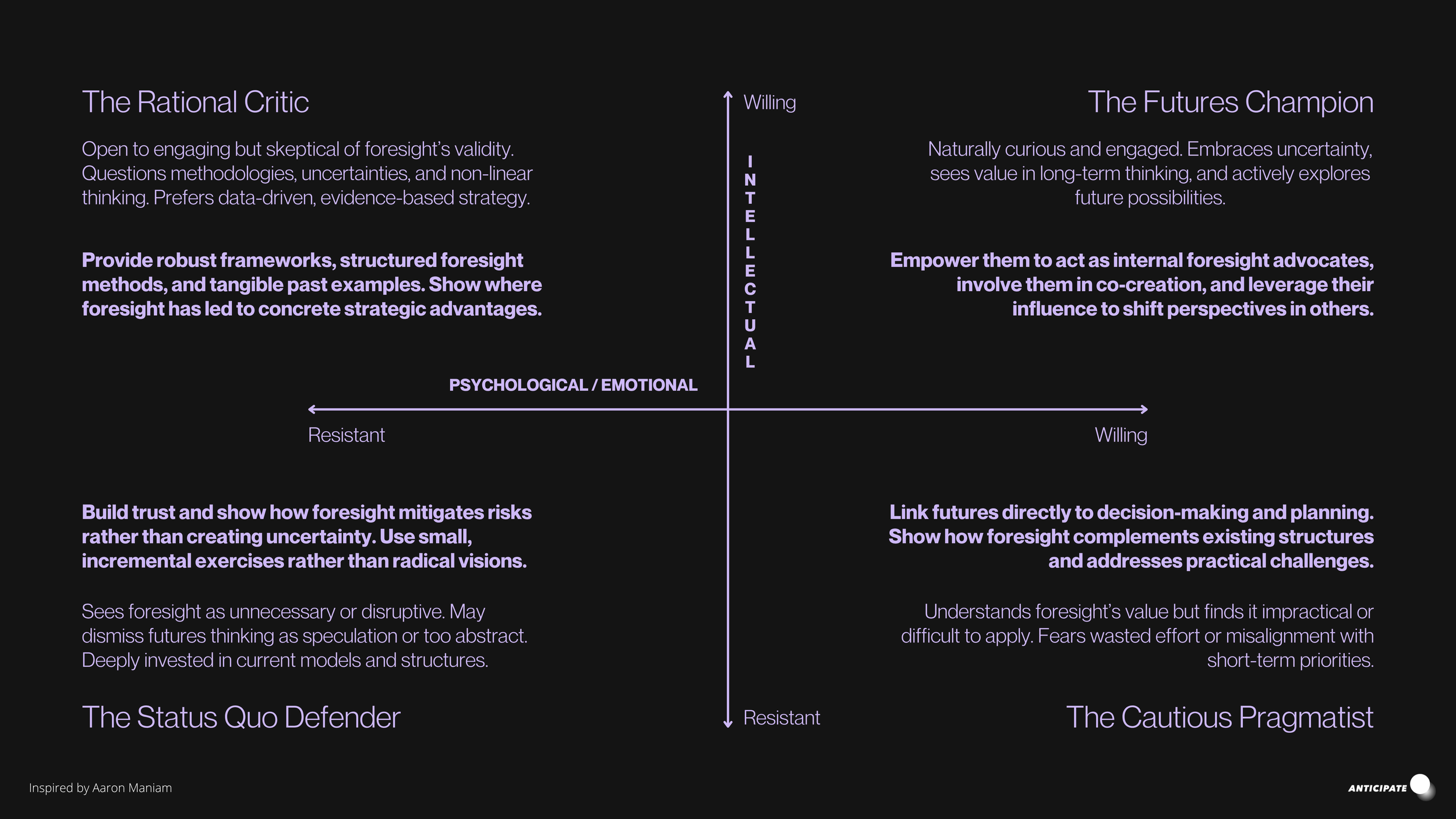
ANTICIPATE, The Foresight Resistance Matrix, 2026 (inspired by Aaron Maniam’s work on reluctance)
Plot the two axes against each other and you get four recognisable people, all of whom you might’ve met. You might even have been some of these in a change process yourself.
The Futures Champion
Willing on both counts, curious, and often comfortable with uncertainty. The mistake here is to spend your energy on them because it feels good. Champions are rarely the main audience (they might be the client), but they're more akin to a distribution network. Give them something to carry: involve them in co-creation, hand them the vocabulary, spread the gospel, let them make the argument in the meetings you're not invited to.
First move could be to ask them to bring the most sceptical person in their department to the next session. That converts their enthusiasm into reach, and it saves you guessing where the resistance sits.
The Rational Critic
Engages willingly enough as a person, but tends to doubt the discipline. They want structure, precedent, and a reason to believe that this isn't astrology for executives. Counter that with robust frameworks, named methods, and use cases with dates and outcomes attached and show where anticipation produced a concrete strategic advantage and where it didn't. Critics who get satisfied become the most credible advocates you'll ever have, precisely because everyone watched them object.
What actually works is to give them the job of quality control. Ask them to stress-test the scenario logic and to tell the group where the assumptions are weakest. The underlying worry is usually not about foresight at all - it's whether their standards will be respected in this room. So make them the guardian of those standards and the objection converts into ownership.
The Cautious Pragmatist
Accepts the logic but might doubt the practicality. They've seen strategy offsites produce beautiful documents that changed nothing, and they fear wasted effort more than they fear being wrong about what could happen in the future.
An opening question to bring would to ask them to name one decision they will personally make in the next six months, then design the output backwards from it. Not a decision the organisation faces, a decision they own. Foresight that feeds a process they're already running beats foresight that competes with it.
The Status Quo Defender
Resistant on both axes, and usually deeply invested in the current model because the current model made them successful. Frontal assault fails here every time and instead what works is trust built slowly, small and low-risk exercises rather than radical visions, and a framing where foresight reduces risk rather than manufacturing uncertainty.
I'd start by asking them what in the current model has to survive to 2036 and why. It honours what they've built, and it gets them into a conversation about change through the door marked continuity. Their answer usually names the organisation's real non-negotiables faster than any interview will.
And then be honest about the arithmetic. A Defender may well be turnable in principle but the question that matters is whether they're turnable inside the life of this project, and whether the effort that would take is worth what you get back. Sometimes the answer is no, and the right call is to route around them instead of spending three months and your credibility on a conversion that was never going to close before the budget did. Andy Hines makes a version of this point in his Foresight Menagerie, which is worth reading alongside this - his cast of characters overlaps with mine, and his bridge-building metaphor is better than anything I've come up with.
The quadrants are less useful as a taxonomy of people than as a diagnostic for a room. During a session or project, I intuitively try to name for myself where each significant participant sits and what their resistance is made of, because the intervention for a Critic actively insults a Defender, and the intervention for a Defender bores a Champion.
Where the resistance shows up matters as much as what it is
Resistance has a timeline. It behaves differently at the beginning of a project, in the middle of a room, and at the point where somebody has to do something with the output.
Before: The part you don’t see in a case study
We rarely talk about selling foresight, which is strange, because it's perhaps the hardest part of the job. The barrier is usually structural rather than personal since organisations run on KPIs, KPIs run on quarters, and almost every incentive that makes a manager successful punishes the horizon at which foresight pays. You can complain about this, or you can work with it.
Working with it means giving foresight its own indicators but not outcome promises you can't own (nobody can attribute a saved decade to a workshop), but output indicators with a why attached to each one. From research pieces published to workshops delivered to stakeholders engaged across functions even to decisions the work fed into and artefacts the organisation still uses six months later. Enough quantification to give yourself a discipline and a language your client already speaks, without pretending to a causality you can't demonstrate.
The other pre-work is diagnostic. Interviews before a project tell you where the non-negotiables sit, who has veto power, and what people are actually afraid of. They also tell you what kind of communicator you're dealing with, which sounds trivial but isn't. Some people are Word people, some are Excel people, some are PowerPoint people (as Aaron Maniam put it), and the same insight lands or dies depending on the container you put it in.
My favourite diagnostic question is the oracle question: if you could ask an oracle one question about the future of your organisation, and get a true answer, what would you ask? People answer it honestly because it's a game, and what comes back is usually the fear and the priority in a single sentence.
Timing belongs here too. Foresight sells differently depending on the “weather” because when things are going badly there's urgency but no bandwidth. When things are going well there's slack and confidence but no felt need. And when things are stable it's hardest of all, because nothing is forcing the question. So you watch for trigger points instead of pushing against the calendar: a new leader who needs a signature agenda, a strategy cycle opening, a regulatory shift, a shock at a peer organisation, or the reliable engine of competitor FOMO. Foresight has a fitness to context, and reading that context is an ethnography of power as much as an assessment of maturity.
During: In the session itself
Inside a session, resistance almost never is simply put forward as an argument. It arrives in one of two forms: people go silent, or people push back out loud. Which is why the diagnosis matters - the behaviour tells you almost nothing about the cause, and the same withdrawal can be a Critic who thinks the exercise is beneath them or a Defender who has worked out where this is heading.
The rush to conclusions is the most common form and the least recognised like when a group (or a person in that group) is uncomfortable with an open horizon, it will close it as fast as possible, usually by leaping to an action list. Meanwhile the questions multiply and the time left on the clock doesn't.
Three things reliably help.
The first is expectation management, done out loud and early. Say what the session will produce and what it won't. Tell the group that they will feel a dip around the middle and that the dip is part of the design. Naming the discomfort in advance turns it from evidence that the workshop is failing into evidence that it's working.
The second is a container. Futures and more specifically scenarios, when they're well built, are a container for fear: they let a group say the unsayable while pointing at a fictional world rather than at each other. The same is true for artefacts. It could be a mock newspaper article from 2050, a fake annual report, a product that doesn't exist yet, all of these give people permission to voice a worry they would never put in a strategy document. Immersion can do what argument can't.
The third is co-creation, which is the least glamorous and most reliable of the three. People buy into what they help make. A scenario handed to a leadership team is a document, but scenario a leadership team built, badly, in ninety minutes, is theirs. If you want a group to defend the work later, make sure their fingerprints are on it in some way or form.
And when someone does push back hard in the room, the move is to take the fire rather than deflect it. If an objection is voiced in front of the group it can become a gift, because it's the one everybody else might already think to themselves. Answer it seriously, in front of everyone, and the room can recalibrate its sense of what's allowed.
After: Where good work goes to die
Plenty of projects survive the room and die in the follow-through, so this is where the pragmatism has to be strongest, because after the session the work has to travel through people who weren't there.
Buy-in can also happen at the end since foresight is iterative (ideally), and a draft circulated with a real question attached converts more people than a finished report ever will. The question worth asking explicitly, because people are wary of the ritual version of it, is whether you are actually interested in their input or performing consultation. If you are, say what you'll do with what they give you, and then show them where it landed in version two. Honesty about how and when input gets used is worth more than any framework.
There's a harder version of this that I've been sitting with since someone put it to me directly. Practitioners talk quite comfortably about some proportion of a room getting it - thirty per cent, maybe fifty on a good day - and treat that as a decent result. But the people who didn't get it aren't neutral. They're the same people who won't defend the output in the meetings you're not in, and who will find reasons not to act on it when it reaches their function. A scenario set that thirty per cent of a leadership team believes in has a ceiling built into it from the day it's finished.
It's tempting to file that under organisational culture and move on. Some of it is. But some of it is ours. If a process ends at thirty per cent, that's partly a fact about the room and partly a fact about how the work was scoped, who was involved in making it, and whether the resistance got hosted or merely got survived. This also complicates the champions-as-distribution-network idea from earlier: distribution only helps if there's somewhere for the work to land. A well-connected advocate can only carry a document as far as the organisation is willing to receive it.
The most common failure is more mundane than any of this. Six weeks later, nothing has moved, and the reason is almost always that the work never attached to a live decision. Go back and find one: a budget cycle, a risk register, an innovation portfolio, a board agenda item. Foresight that isn't plugged into an existing decision is a nice afternoon, and everyone in the building knows it.
It also helps to be clear that foresight is a means to an end rather than a destination. Nobody wants to become a futures organisation. They want to make a better decision about a factory, a portfolio, a mandate. Tell people what foresight isn't, as clearly as what it is, and much of the intellectual resistance evaporates before it forms.
The timeline is a diagnostic in its own right. Resistance at the start is a scoping problem: you're in the wrong room, or the wrong people are in it, or the work isn't attached to anything that matters yet. Resistance at the end is a relevance problem: the work is finished and nobody can see what it's for. Same behaviour, different cause, different fix.
Underneath: The resistances that aren't about foresight at all
Some resistance runs deeper than method or incentive.
There's an identity layer, which shows up as a question about standing: who are you to be messing with our future? Underneath the methodological phrasing, this is often closer to I don't like you, or at least I don't trust what you represent. It's a knowledge claim about the knower rather than the knowledge, and it's the reason external consultants sometimes fail where an internal champion with a worse deck succeeds. The answer isn't credentials. It's relationship, and relationship takes time.
There's a spiritual layer, which I've met more often than I expected, and not only in the places you'd assume. The future is not ours to play with. Don't tempt fate. The framing that has served me best here is that we're not making the rain, we're handing out umbrellas. Foresight isn't a claim to know what will happen. It's preparation for the range of what might.
And there's the epistemological layer, the one that sounds like a dead end: if the future is truly unknowable, why are we doing this at all? This is the objection I most enjoy, because the honest answer is better than the defensive one. We don't do futures work to know the future. We do it to understand our beliefs about the present, which is where every strategy is actually made. Scenarios, metaphors and stories are instruments for re-perceiving what we already think we know. That reframe converts more sceptics than any accuracy claim ever will.
Finally, resistance is stratified. A board fears reputational and regulatory exposure. An executive team fears distraction and cost. Middle management fears more work, unclear ownership, and being made visible. The frontline is often the most willing group in the building and the least often invited. Ask yourself which level you are actually meeting resistance at, because the same intervention across three levels is three different conversations.
Purity versus pragmatism
Here's the uncomfortable part. A lot of foresight resistance is provoked by foresight people.
If the word "futures" closes the door, call the work something else. Strategic planning, risk anticipation, long-range portfolio review, scenario stress-testing. Call it what you need to call it to get the meeting, and do the real work once you're in the room. Aaron put it more bluntly than I would have: be a dancing monkey if the dance serves the purpose. That kind of intellectual dexterity isn't a compromise of the discipline, it's a condition of practising it inside organisations that were not built for it.
There is a zone in the middle, between what you consider methodologically sound and what the client can accept, and the work happens in that zone. It's a negotiation, not a surrender. You hold your non-negotiables (usually plurality of futures, honesty about uncertainty, and participation) and you flex on everything else: vocabulary, format, length, how much theory gets shown. Leaders have already been successful at something difficult. Speaking their language is a form of respect before it's a tactic.
Saying it out loud
The most counter-intuitive thing I've learned is that fear in a room isn't only a problem to be managed. Handled well, it's a source of solidarity. When a group admits collectively that they're worried about the same thing, something opens that no amount of trend data will open and he facilitator's job in that moment is to create a response, and to make the room safe enough that the fear can be said in the first place.
That's also the strongest argument for who gets to be in the room. Some of the most productive sessions I've run involved listening to young people describe the futures they expect to live in, in front of the adults who are currently making decisions about them. Nobody argues with a fifteen-year-old about methodology.
So:
Expect resistance, and don't treat it as a verdict on the work. Diagnose whether it's intellectual or emotional, and check twice, because the second one dresses as the first.
Notice which level of the organisation it's coming from and when in the timeline it arrived. Then choose your move accordingly, decide honestly whether this particular person is turnable inside the life of this project, and accept that most of this happens slowly.
We're not making the rain, we're handing out umbrellas, and quite often we're doing it before anyone has noticed the sky.
The two axes come from Aaron Maniam's session on reluctance in foresight at the Dubai Future Forum 2024. The archetypes, and any errors in them, are mine. Thanks also to those who pushed back on an earlier version of this thinking on LinkedIn - several of the sharper points here started as their objections.
If you want to learn more, check out The Foresight Facilitator, where dealing with a resistance is a central component.
(STAY TUNED FOR MORE HERE: https://tally.so/r/Bz7WAQ)
A live, online learning experience for people who want to get better at guiding futures conversations, with teams, clients, and communities.
Foresight often lives in abstraction: imagination, uncertainty, tensions, and questions that don’t come with neat answers. That’s exactly why facilitation matters. It’s the craft that turns futures thinking into a shared experience people can move through, and decisions they can carry forward. Most foresight trainings focus on methods and outputs. This experience focuses on what’s usually skipped: how you hold the room.
Across two 3-hour live sessions, you’ll work through a practical arc — Design, Develop, Deliver, Debrief — and build a facilitation style that is clear, grounded, and adaptable. Between sessions, you’ll team up to prepare a micro-workshop, supported by a light coaching touchpoint.
In the second session, you’ll deliver it, receive coached critique, and sharpen your debrief muscle so the learning sticks.
Format: 2 live online sessions of 3 hours each (+ light mentoring/homework in between)
Dates: Upcoming dates TBD
S1: Design & Develop
S2: Deliver & Debrief
(participation in both sessions is necessary for a good learning outcome)
Time: TBA
Cohort size: 12 participants
We also offer this as team trainings.
Note: If you want to purchase a seat on behalf of an organization, reach out to us separately for an invoice.
A limited number of discounted places may be available for participants from NGOs, civil society, or people / organisations financially constrained in these uncertain times If price is a barrier, please reach out and we’ll explore what is possible. Contact hi@anticipate.dk.
PRICES NOW INCLUDING VAT
Note that store prices are now shown inclusive of applicable VAT. For customers in the EU, the VAT portion is calculated using the rate applicable in your country. Our Danish VAT number: DK45996689