Refracting the Futures: Megatrends PRISM
A five-lens framework — Possibilities, Risks, Inquiries, Signals, Mindsets — for translating megatrends into decisions your organisation can act on.

Photo by Braxton Apana on Unsplash
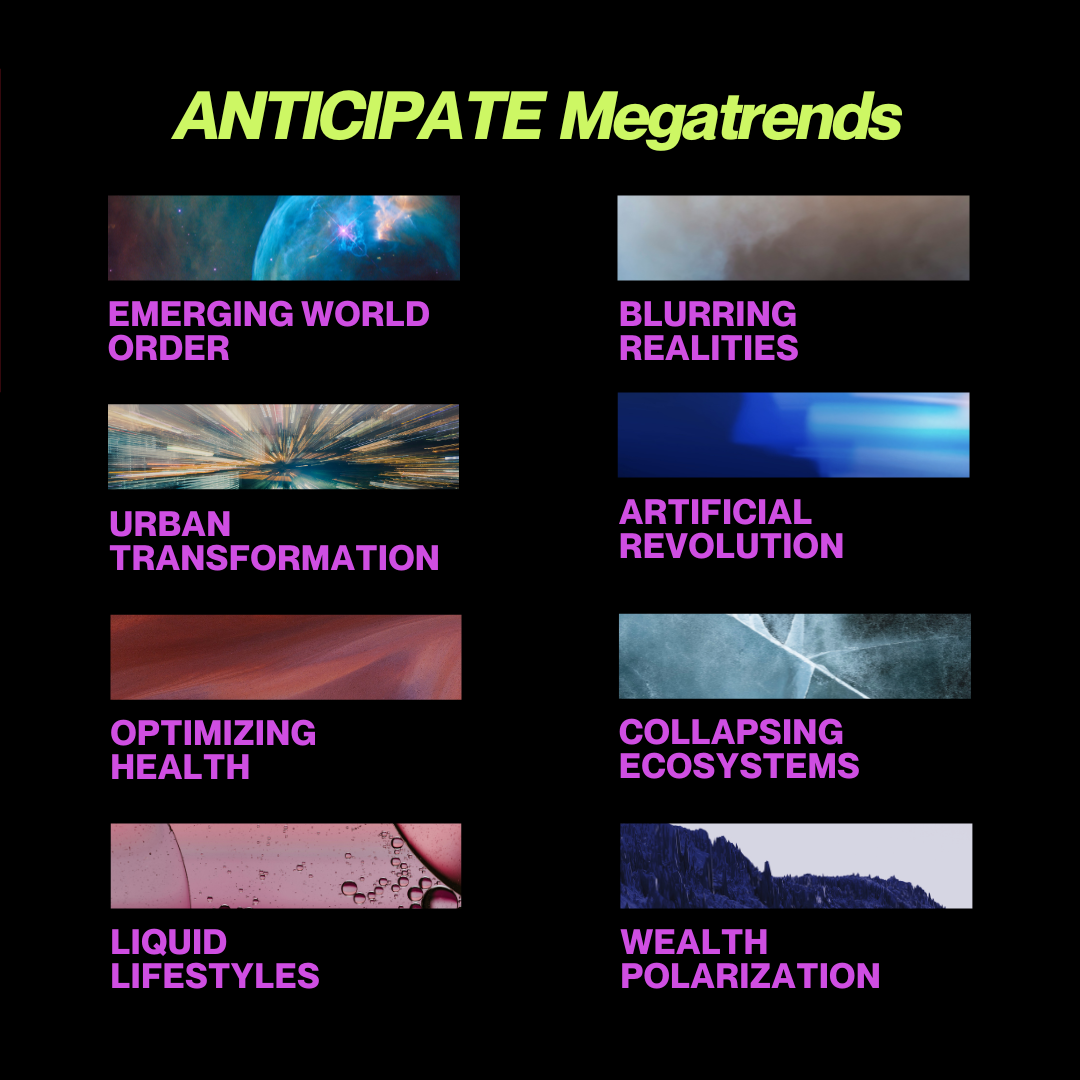
When we published the ANTICIPATE Megatrends in April 2025, the ambition was clear: to provide a structured lens on eight global forces reshaping how we live, work, govern, and innovate. The launch webinar in May brought together a wide community of practitioners, strategists, and policy professionals. The conversations were thoughtful, critical, and wide-ranging.
And yet, in the months that followed, one recurring question surfaced across sectors: “We understand that these are Megatrends. But how do we translate them into something actionable for us?” That question is not trivial. Megatrends are, by definition, high in impact and high in complexity. They operate across systems and time horizons. They are structural rather than episodic. And we need to translate them into context.
But the people who need to work with them, from leaders, educators and civil servants, designers, investors and the general public. must make decisions within concrete realities. That’s why it was important to us to develop a tool to tackle the translation gap between these high-level forces and more strategic considerations. The Megatrends PRISM was developed along with the framework to close exactly that translation gap.
Over the past year, it has been tested and refined in contexts ranging from the OECD Foresight Community to design education strategy in Spain, from Danish business leadership workshops to research on the futures of impact investing. It has proven to be both accessible and quite rigorous, a rare combination in foresight tools.
This article reflects on why the PRISM was created, the theoretical logic underpinning it, and what we have learned from applying it in practice.
The translation problem in foresight
Megatrend frameworks are not new. Governments, consultancies, and think tanks have long published reports outlining global drivers of change: demographic shifts, technological acceleration, geopolitical realignment, climate pressures. And we took offset in many of those when we built our own.
So the challenge is rarely awareness that they exist, it’s more a question of application.
In many organisations, Megatrends remain either:
A slide in a strategy deck, acknowledged but not internalised.
An abstract report that informs discussion but not decisions.
A conceptual layer disconnected from daily operations.
What was missing was a structured way to move from “This is happening globally” to “This is what it means for us”.
Foresight literature has long emphasised the importance of interpretation and contextualisation. As scholars such as Richard Slaughter and Joseph Voros have argued, foresight is not about accumulating information but about developing the capacity to make sense of change in ways that inform action. Similarly, the field of anticipatory governance highlights the need for mechanisms that link long-term analysis to present-day institutional choices.
The PRISM was designed as such a mechanism.
It offers a disciplined yet flexible process for refracting megatrends into implications that are strategic, ethical, and actionable.
Why a PRISM?
The metaphor of the prism is very deliberate.
In physics, a prism refracts white light into a spectrum of colours. The light was always complex; the prism reveals that complexity by bending and separating it into visible components.
Megatrends function in a similar way. They often appear singular—“Artificial Revolution”, “Emerging World Order”, “Collapsing Ecosystems”. But when examined more closely, each contains layers of opportunity, tension, uncertainty, and assumption.
Megatrends, important to acknowledge, is a starting point for foresight work. And without refraction, Megatrends risk becoming either too simplistic or too overwhelming to use for even that.
The PRISM refracts a megatrend through five lenses:
Possibilities. Risks. Inquiries. Signals. Mindsets.
These lenses are grounded in core principles of futures and foresight practice.
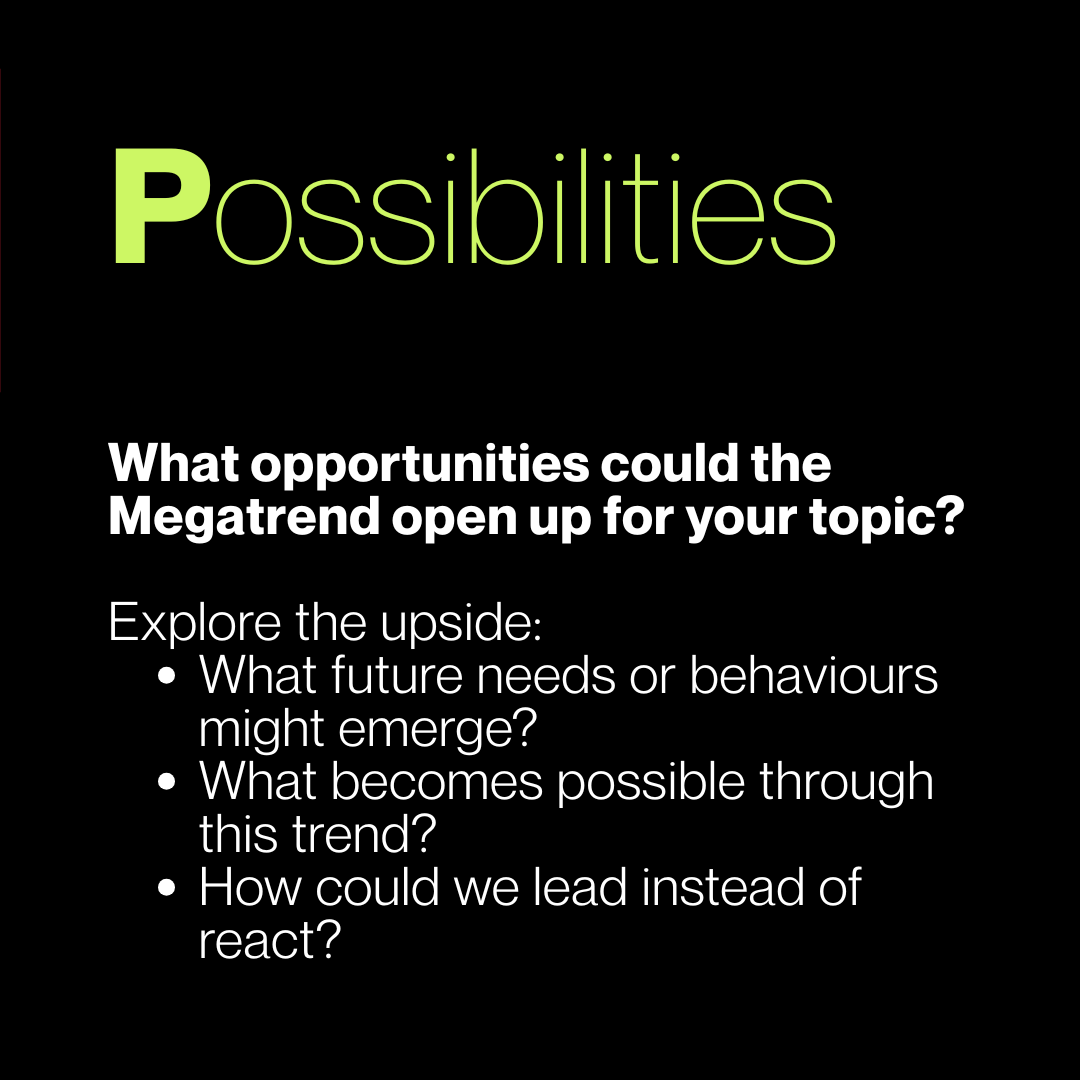
Possibilities. Expanding the opportunity space
Futures thinking begins by widening the opportunity space. Too often, megatrends are framed through fear or inevitability.
Artificial intelligence is described primarily in terms of job displacement. Geopolitical realignment is reduced to instability. Climate breakdown is equated with collapse and only collapse.
These risks are real and must be addressed, but focusing exclusively on downside narrows strategic imagination.
The Possibilities lens asks:
What constructive pathways could emerge from this shift?
Where are openings for innovation, resilience, or regeneration?
For example, in work on the future of impact investing, the megatrend of Wealth Polarization initially generated discussions about inequality, political instability, and systemic fragility. Through the Possibilities lens, the conversation shifted toward new financial instruments for inclusive growth, blended finance models, and community-based capital structures.
Similarly, in design education workshops, the Artificial Revolution megatrend prompted concerns about automation and homogenisation, ‘grey’ futures. The Possibilities lens opened space for exploring AI as a tool for expanding creative capacity, personalising learning, and enabling cross-disciplinary collaboration.
Possibilities do not deny challenges or deem them any less important but rather shows that we can innovate our way into better futures.
Risks. Investigating the undesirable
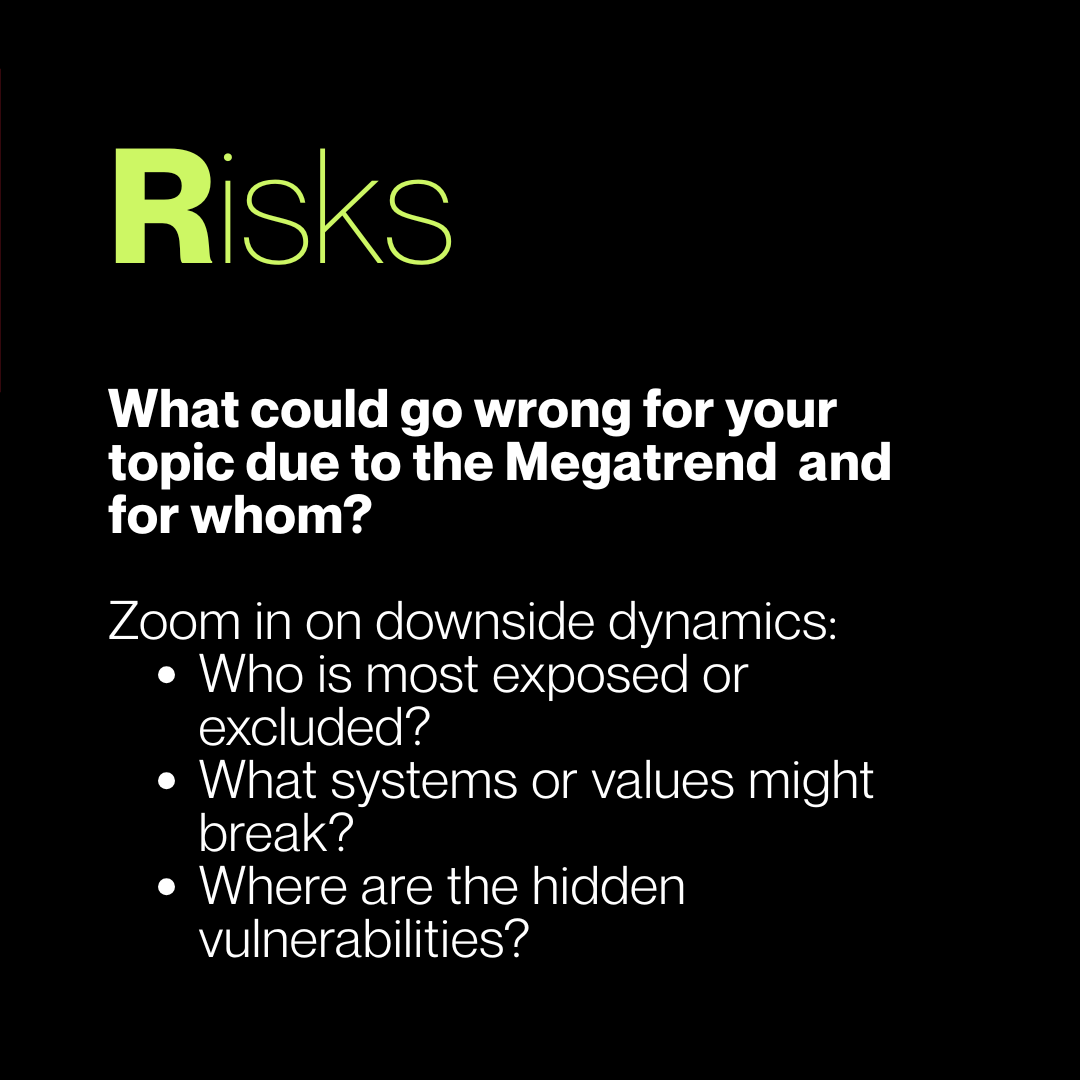
Balanced foresight requires confronting vulnerabilities directly and the Risks lens moves beyond superficial acknowledgement to probe structural exposure:
Who benefits and who loses?
What dependencies could become liabilities?
Where might unintended consequences arise?
In governance workshops, for instance, discussions around Emerging World Order revealed tensions between national sovereignty and multilateral cooperation, both political priorities in many countries. Participants identified risks related to weakened global institutions and economic coercion.
In business settings, discussions of Collapsing Ecosystems highlighted supply chain fragility, material scarcity, and reputational exposure tied to environmental degradation.
Inquiries. Probing uncertainty
One of the most overlooked yet most critical aspects of futures work is disciplined questioning. The more uncertainty we face, the more important it becomes to ask the right questions instead of trying to provide ‘correct’ answers.
Organisations often feel pressure to move quickly from analysis to action. Yet foresight requires space for uncertainty.
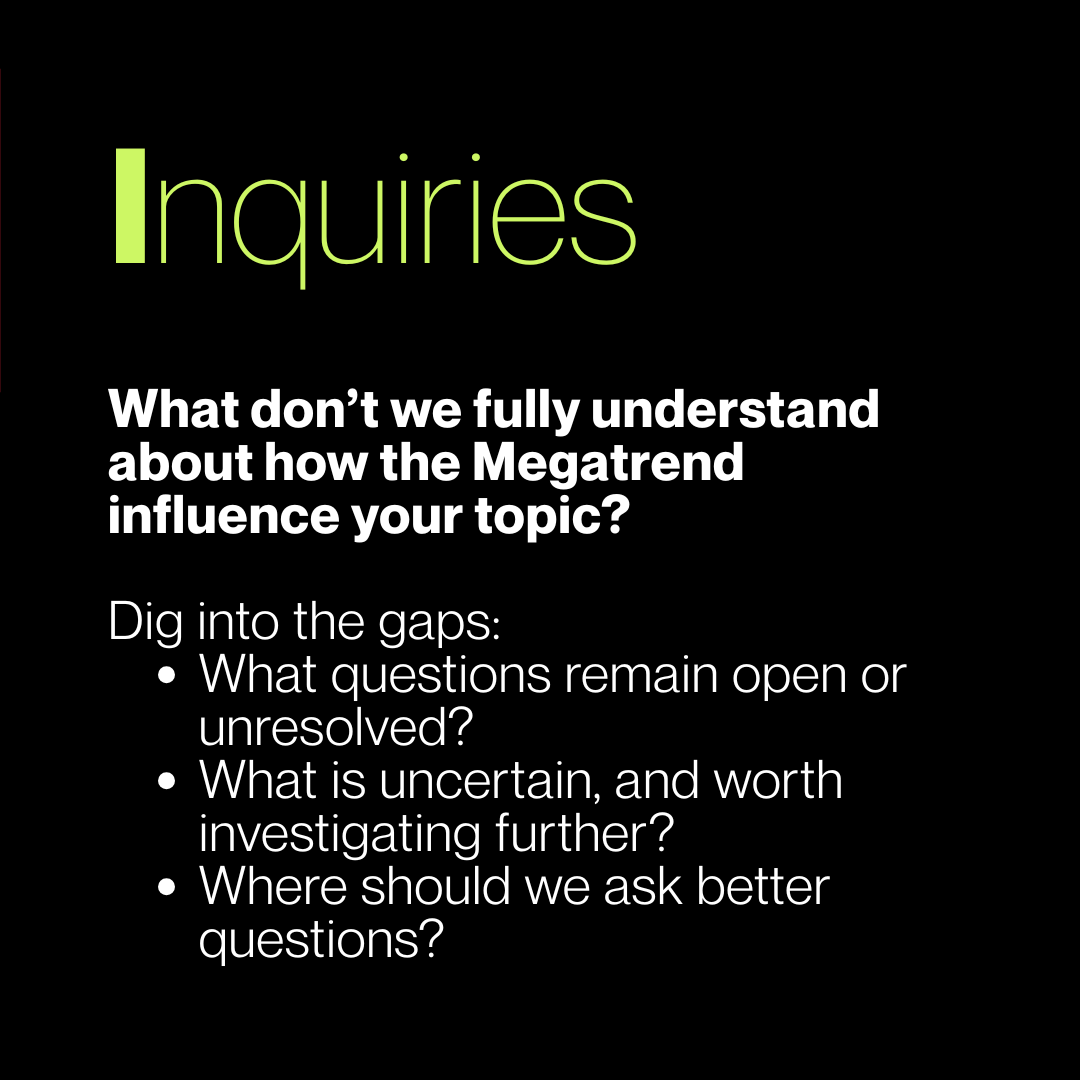
The Inquiries lens asks:
What do we not yet understand?
Which assumptions need further testing?
What research, experimentation, or dialogue is required?
In the context of anticipatory governance, inquiries surfaced questions about regulatory adaptability in the face of AI-driven decision systems. Rather than rushing toward policy prescriptions, participants identified areas requiring deeper legal and ethical exploration.
In research on impact investing, the Inquiries lens highlighted unresolved tensions between fiduciary duty and systemic impact, suggesting the need for new accountability metrics and governance models.
This lens reflects a core insight from futures studies: the quality of our questions shapes the quality of our futures.
Signals. Making Change Visible
As the saying goes, seeing is believing and if we are faced with too much abstraction, it can undermine engagement. So we need to point fingers towards the spaces where we already see traces of the futures in the present.
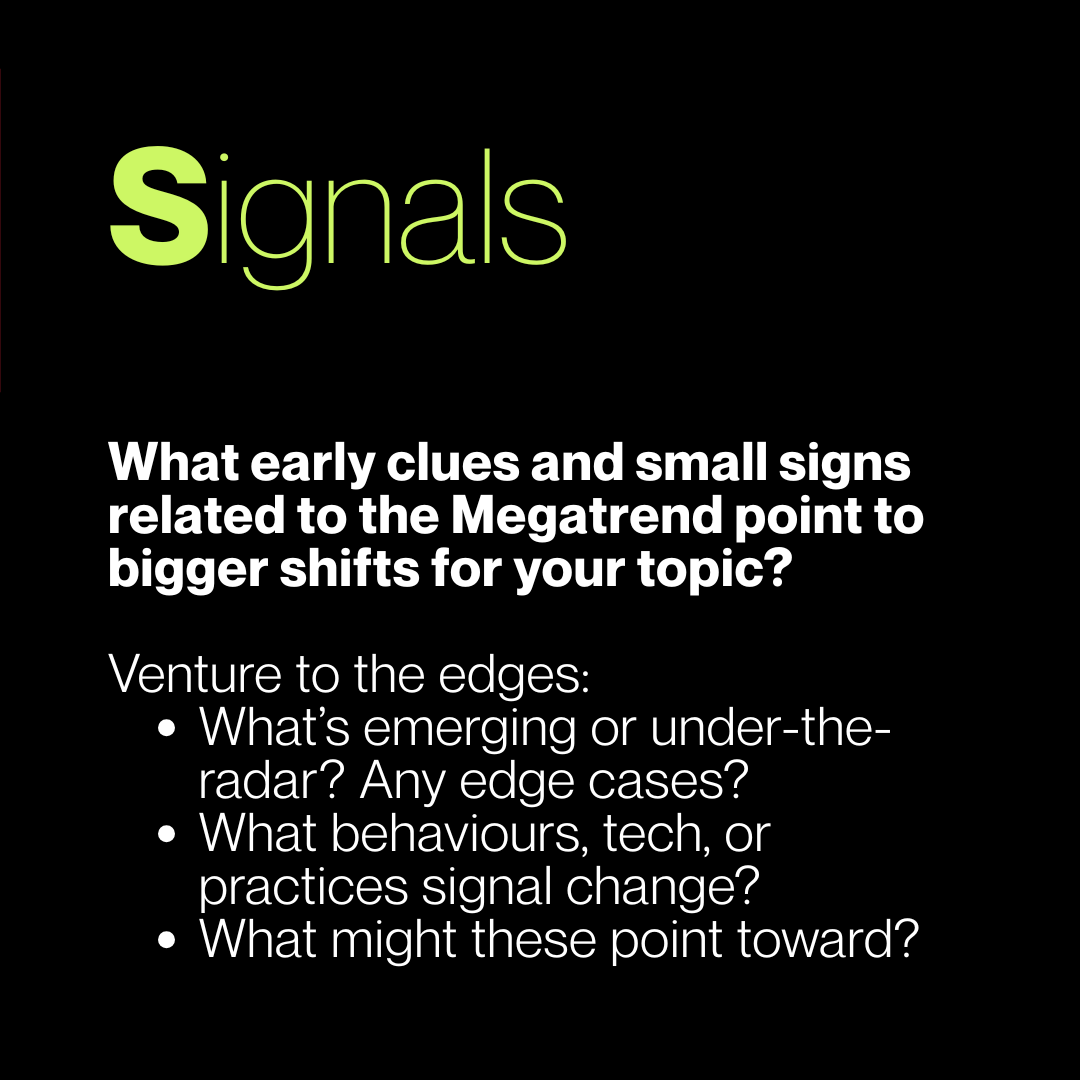
The Signals lens grounds Megatrends in observable evidence:
Early adopter behaviours
Policy experiments
Emerging business models
Technological prototypes
In Danish leadership workshops, participants connected artificial revolution to concrete signals such as how companies are setting up AI-driven laboratories operating outside traditional institutional hierarchies, hire AI colleagues to help with specific tasks or even have retrained colleagues to be Human-AI facilitations. reshoring initiatives, energy independence strategies, and defence investments.
Signals serve two functions. They build credibility, demonstrating that shifts are already underway, and they stimulate imagination by showing that alternatives exist.
Seeing fosters belief, belief fosters agency.
Mindsets. Surfacing assumptions
Foresight is as much about internal transformation as external awareness.
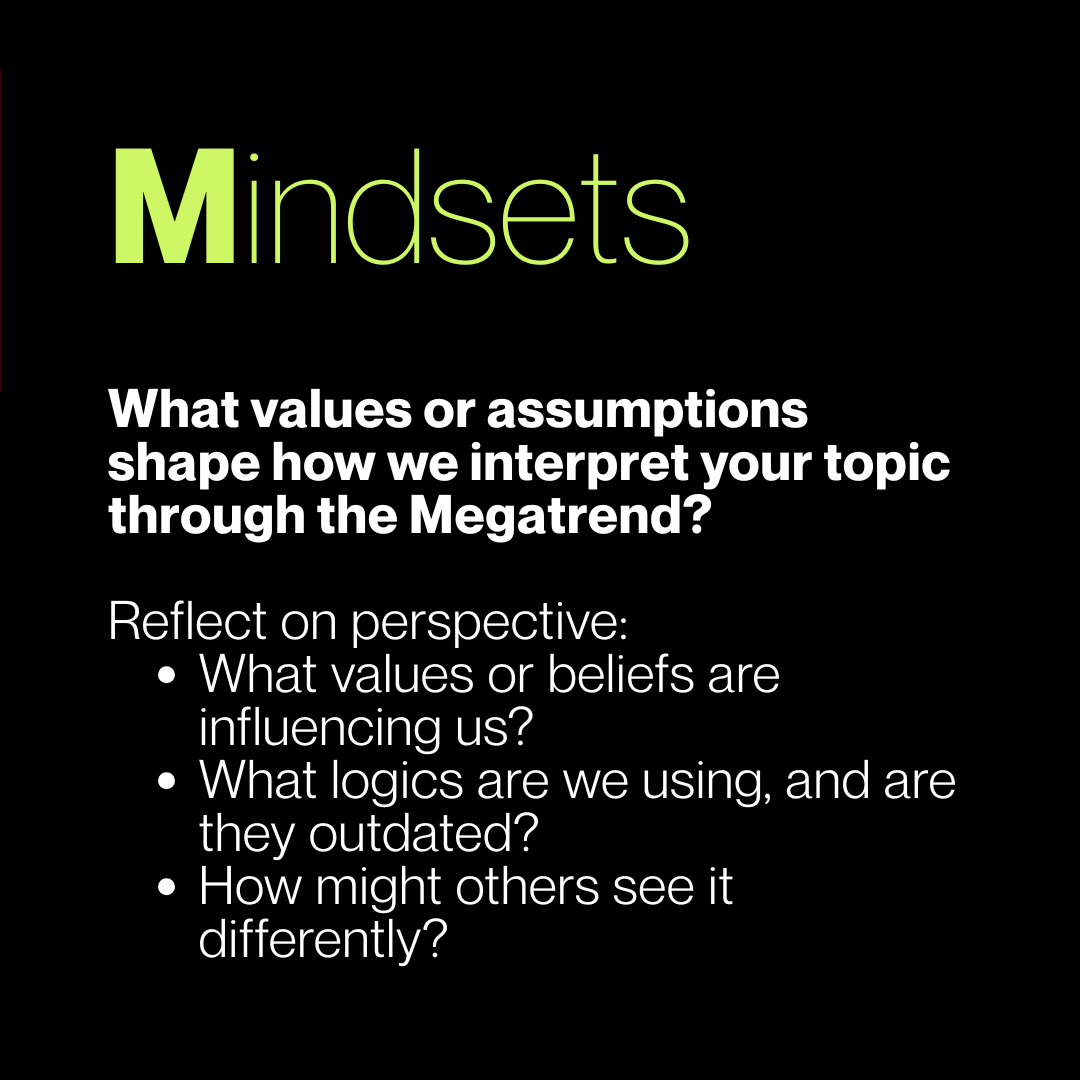
The Mindsets lens invites reflection on:
Institutional logics
Cultural assumptions
Leadership biases
Dominant narratives
In one session, a discussion about Liquid Lifestyles revealed fundamentally different mindsets among participants. Some framed fluid identities, flexible work patterns, and shifting consumption habits as opportunities for personal freedom and market adaptability.
Others expressed concern about erosion of stability, belonging, and long-term commitment. Surfacing these frames shifted the conversation from lifestyle trends and customer segmentation to deeper questions about identity, community, and what kind of social fabric the organisation wanted to support.
Mindsets shape interpretation and interpretation shapes strategy. Without examining that, even the most sophisticated Megatrend analysis remains incomplete.
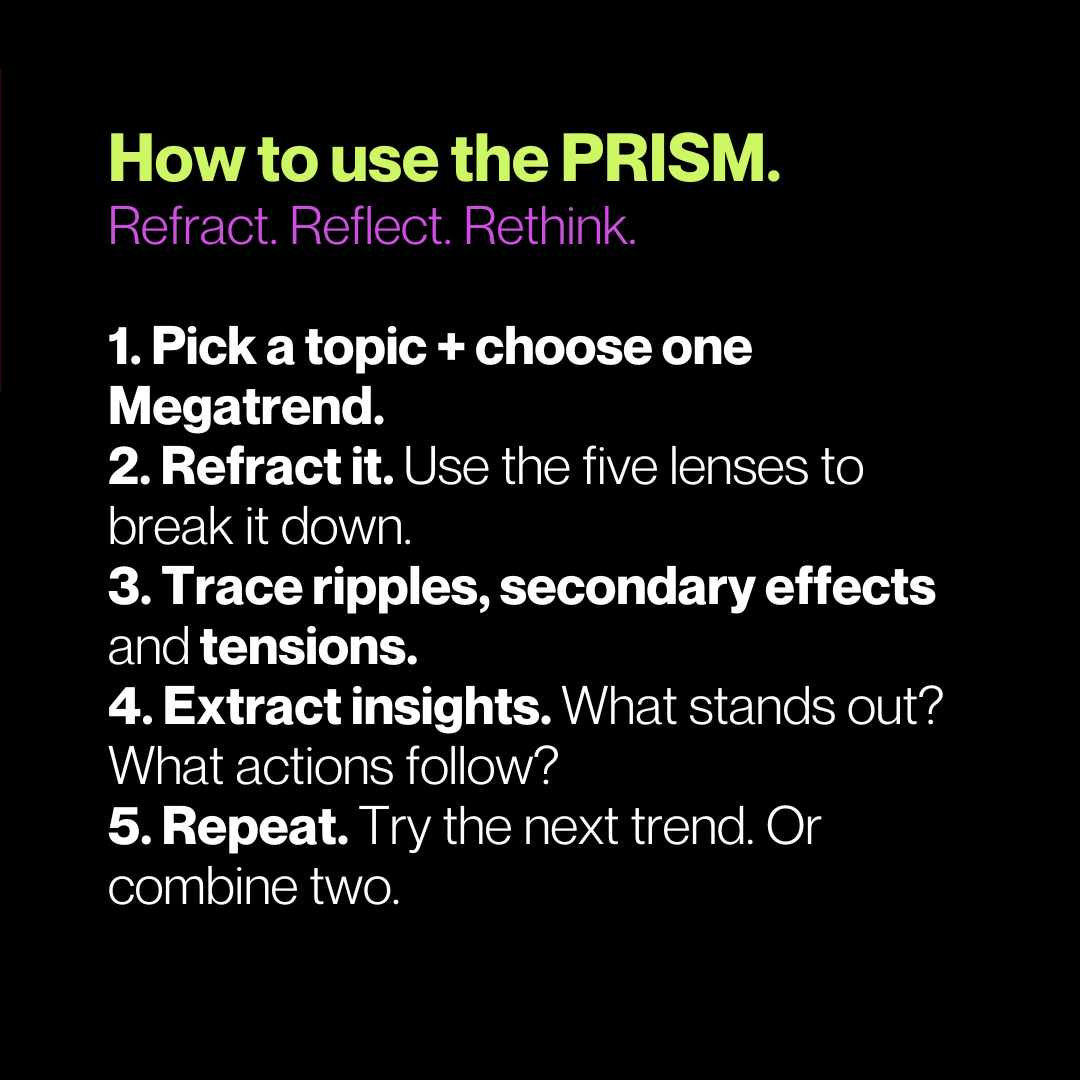
From framework to practice
Once teams have surfaced the immediate Possibilities, Risks, Inquiries, Signals, and Mindsets, something shifts. The conversation becomes more confident. The room becomes more curious. And that is when we move from analysis to depth.
This is where the PRISM evolves. There are three primary route ways to add depth to the method.
Ripple effect: When the ripples start to show
Megatrends rarely operate as isolated drivers. Their true power lies in their second-order effects, the ripples they create across systems.
Take the Artificial Revolution. The direct impact may be automation, data acceleration, or AI-enabled decision-making. But the ripples? Those extend into labour markets, education systems, governance structures, cultural norms around creativity, and even our understanding of accountability.
Or consider Collapsing Ecosystems. The immediate discussion often revolves around climate regulation, resource scarcity, and biodiversity loss. But the ripples touch food systems, insurance markets, migration flows, political stability, and capital allocation strategies.
When we ask teams to look 2, 5, or 10 years ahead (and not just immediate impacts), the megatrend begins to stretch. It stops being a headline and becomes a trajectory. Imagine a Futures Wheel but for Megatrends where 2nd and 3rd implications, and different time dimensions are considered.
That stretching is what separates passive awareness from anticipatory thinking.
Interconnections: Where forces intersect
The next layer is perhaps even more revealing.
Megatrends rarely move alone, they collide, they reinforce each other and they counterbalance.
Urban Transformation intersects with Artificial Revolution in the rise of smart cities, algorithmic governance, and new forms of public participation. Wealth Polarization intersects with Blurring Realities in questions of access to digital spaces and influence over information ecosystems. Emerging World Order intersects with Collapsing Ecosystems, reshaping energy systems, supply chains and redefining resilience as a geopolitical concept rather than a purely environmental one.
When we intentionally map these intersections, the conversation becomes systemic. This level is often where strategic blind spots emerge.
A Megatrend that felt manageable on its own may look volatile when combined with another. A perceived threat may reveal itself as an opportunity under different structural conditions and what looked like incremental change may suddenly appear as exponential.
Strategy: From exploration to strategic clarity
Only after exploring ripples and interconnections do we move toward strategic takeaways.
Instead of being seen conclusions or fixed answers, this has more to do with clarity over what we need to do.
What critical insights have surfaced? Where are the leverage points? What actions are worth prototyping? Which signals deserve monitoring? Where should we build capability? Where should we hedge? Where should we lean in?
At this stage, Megatrends stop being contextual background and become directional input.
In a recent workshop with academic leaders in Spain, the PRISM process led to a simple but powerful insight: across all megatrends, a more human-first approach to technology was necessary. That clarity did not simply emerge from reading a report. It emerged from refracting, stretching, connecting, and debating.
In impact investing research, the framework revealed that long-term capital allocation could not be separated from shifts in political narratives and demographic dynamics. The insight was not necessarily new, but the systemic linkages became visible in a new way.
Strategy is built more on shared understanding than information in isolaion.
Accessibility without simplification
The PRISM has been used in formats ranging from short leadership sprints to multi-day strategic workshops. It has supported:
Early-stage innovation processes
Curriculum development in higher education
Governance dialogues on democratic resilience
Research synthesis on systemic finance
Participatory foresight exercises in international networks
And more…
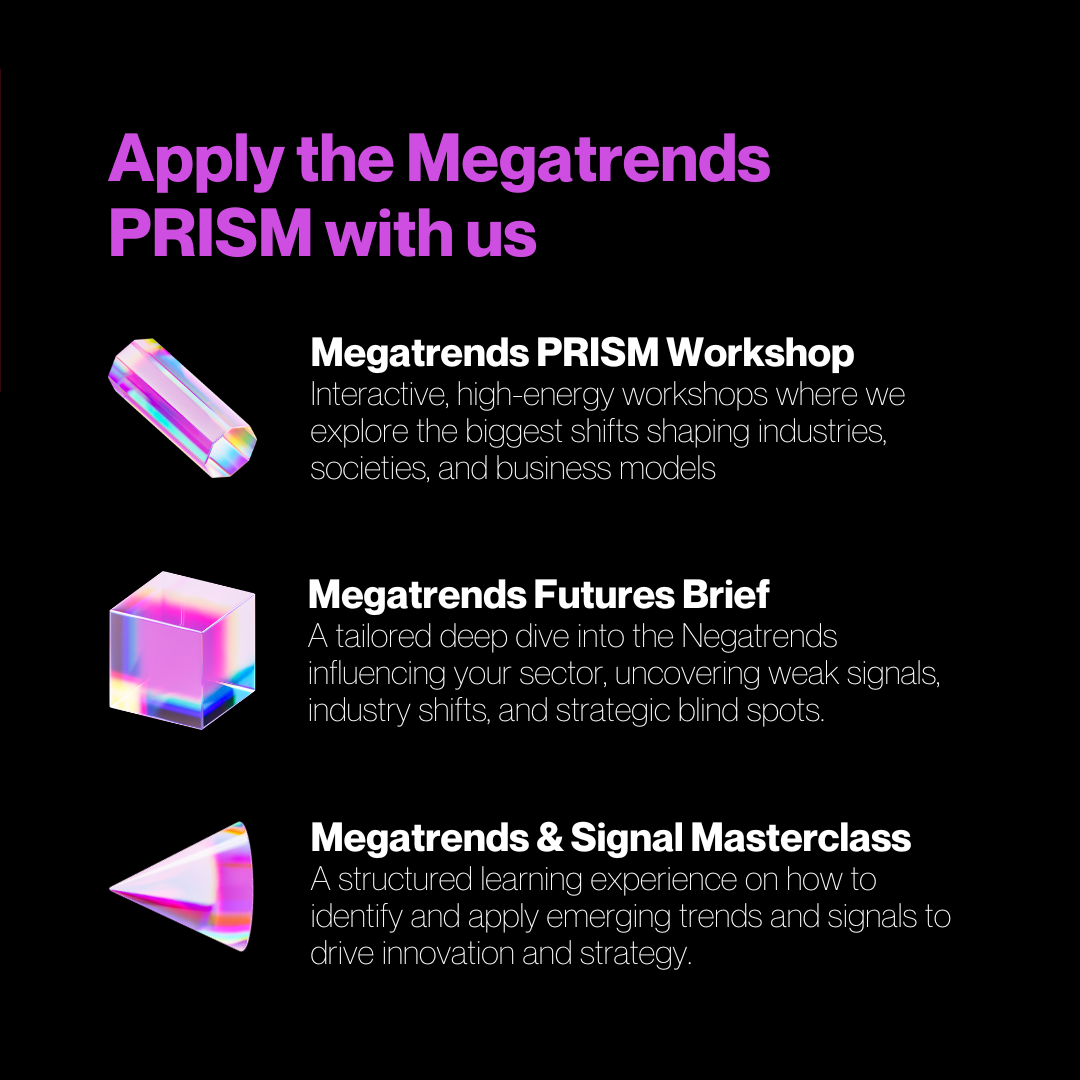
In one design education workshop in Spain, participants refracted eight megatrends through the PRISM and then clustered insights into thematic areas—Glocal Futures, Learning Futures, Cultural Futures, and Sustainable Futures. The output was a set of strategic provocations that now inform the next phase of strategy development.
In Danish business leader sessions, physical megatrend cards were introduced to facilitate tactile engagement, where the simple act of placing and moving cards enabled richer discussion of interconnections and influence.
A guiding principle in developing the PRISM was accessibility without dilution.
Foresight often suffers from two extremes: overly technical academic discourse or overly simplified trend lists. The PRISM aims to sit between these poles, offering structure without too much rigidity and encouraging participation without sacrificing depth.
For organisations asking how to begin with foresight, the PRISM provides a starting point. It is intuitive enough for newcomers yet robust enough for experienced practitioners.
After nearly a year in use, one lesson stands out: Megatrends alone are insufficient, translation is essential.
The PRISM is one way to ensure that global forces of change do not remain abstract concepts but become meaningful inputs into real decisions. We need methods that help us interpret, question, and act.
Refracting the futures helps with just that. It offers structured exploration. And in a world where complexity often overwhelms decision-making, that structured exploration may be the most valuable capability of all.