
Rewriting the Story Beneath the Strategy
Causal Layered Analysis workshop with Development Dynamics
Helping a pan-African think–do–through organisation move through a strategic inflection point by examining the deeper narratives shaping its identity, mission, offering, and structure.
Challenge
Development Dynamics operates at the intersection of systems change, impact, and foresight across Africa. The organisation was entering an important transition: its work had generated considerable insight, relationships, and possibility, but the richness of that work was also becoming difficult to hold together.
The challenge was not a lack of ideas. It was, in the organisation’s own framing, the weight of richness.
Development Dynamics needed to simplify without flattening its ambition: to distinguish what was core from what was enabling, clarify what it wanted to be known for, and identify what might need to be strengthened, redesigned, or deliberately left behind. What had brought the organisation to this point would not automatically carry it into its next stage.
The workshop also arrived at a specific point within a wider foresight and strategy journey. The team had been strengthening its understanding of structural drivers shaping the African development ecosystem and was preparing to move into scenario development. Before doing so, it needed to look inward and explore a different set of questions:
What story currently sits beneath the strategy?
Which assumptions are quietly shaping organisational choices?
And what deeper narrative could support the next chapter with greater coherence and integrity?
Approach
Rather than offering another conventional strategy session, ANTICIPATE designed and facilitated a four-hour online Causal Layered Analysis workshop, delivered through Zoom and Miro.
Causal Layered Analysis, developed by Sohail Inayatullah, helps groups move beyond visible problems into the systems, worldviews, and underlying myths or metaphors that shape how an organisation understands itself. Crucially, the method does not stop at diagnosis. It supports teams in developing new narratives and considering which systems and visible actions could make a preferred future more plausible.
The workshop followed a deliberate down-and-up arc.
1) Opening, grounding, and relational context
The session began with a short grounding exercise, followed by introductions that invited participants to share something beyond their formal roles. This created space for a more reflective and honest conversation before moving into the strategic material.
We then introduced the logic of CLA, clarified why it was especially relevant at this stage of Development Dynamics’ evolution, and established what a useful outcome would look like.
2) Going down through the layers of the present
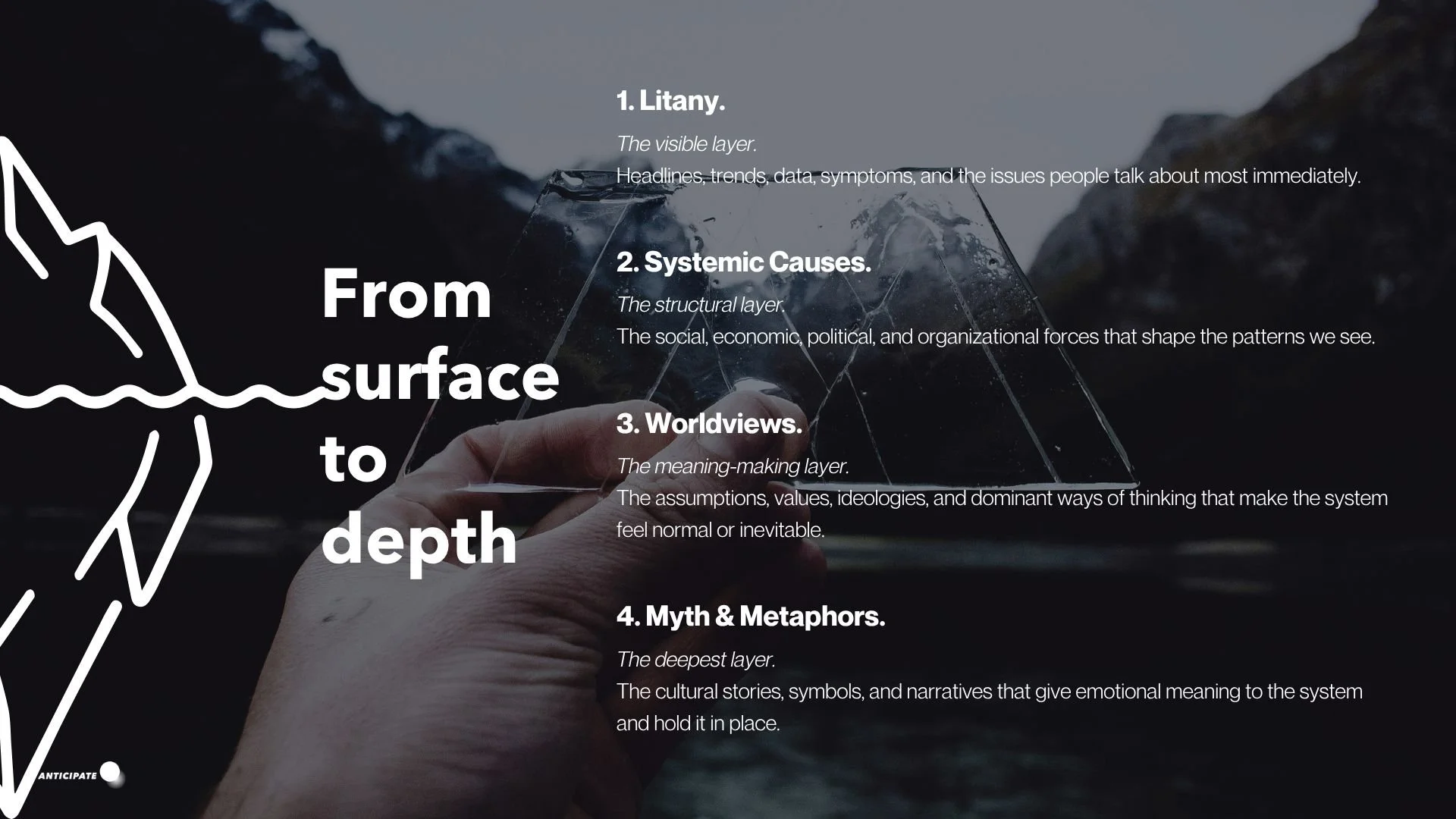
In small groups, participants explored Development Dynamics through four levels:
Litany: the visible issues, concerns, descriptions, and recurring statements about the organisation
Systems: the structures, incentives, processes, relationships, and external conditions producing those visible patterns
Worldviews: the beliefs, values, and models of change that make the systems appear logical or necessary
Myths and metaphors: the deeper stories, images, and emotional narratives shaping how the organisation sees itself and its role
The aim was to uncover where different parts of the organisation saw Development Dynamics similarly, where perspectives diverged, and which hidden assumptions were influencing strategic choices.
A shared “parking lot” captured important questions that did not fit neatly into the map, allowing complexity to remain visible without derailing the exercise. Participants then returned to plenary to identify repeating patterns, meaningful differences, and the tensions that required further attention.
3) Rebuilding upward toward preferred futures
For the second round, participants were deliberately mixed into new groups. Beginning with the metaphorical layer, they explored what might change if the organisation adopted a different underlying story.
They worked upward through:
New myth or metaphor → future worldview → enabling systems → visible future reality
The guiding question was:
If we shift the underlying story, what changes in how we operate and what we are known for?
This helped connect identity and meaning to organisational design. A new story was not treated as branding language, but as something that would need to produce different choices, structures, partnerships, and behaviours.
4) Translating the analysis into four strategic pillars
The final hour moved from layered exploration into practical prioritisation.
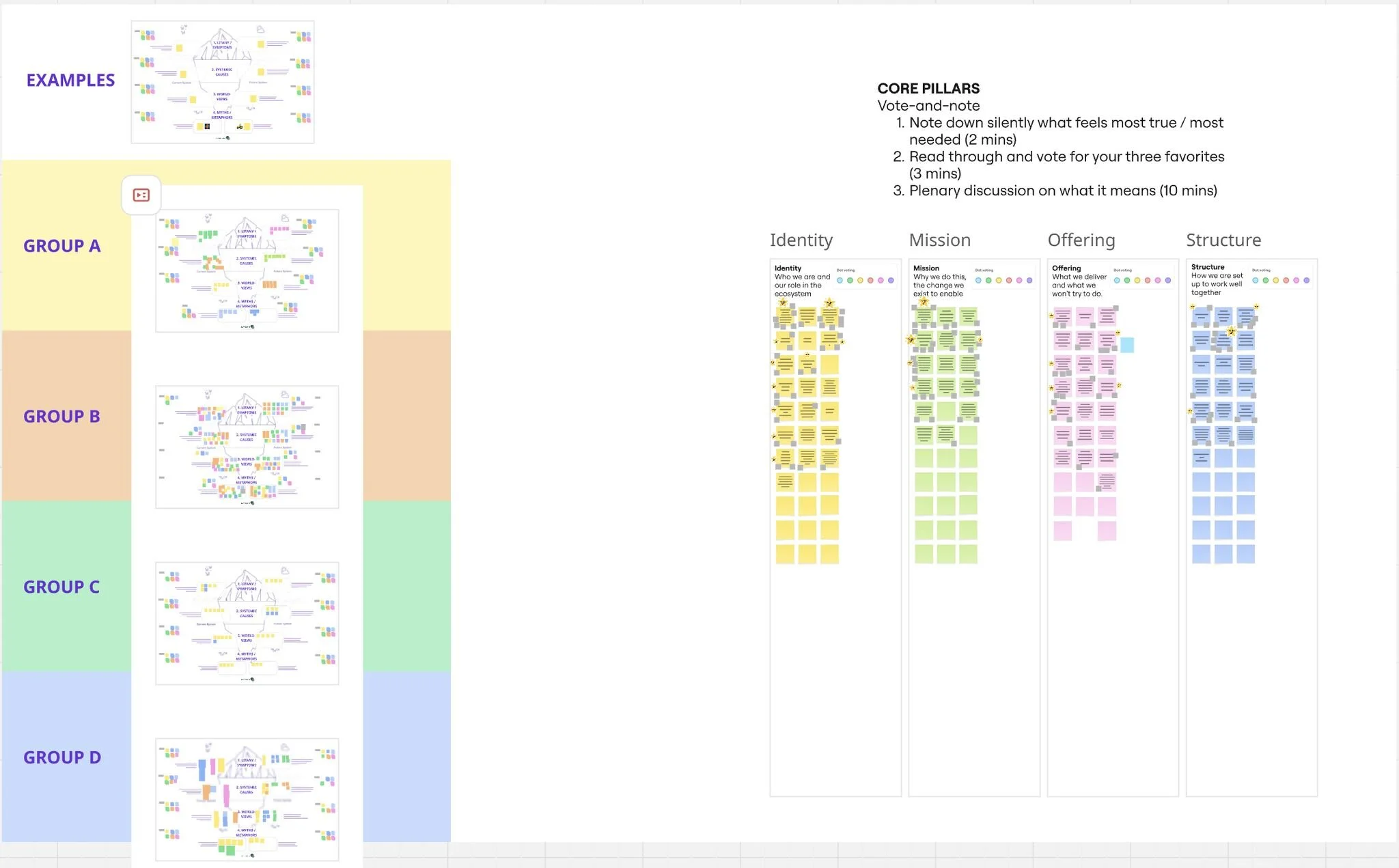
The insights were organised around four pillars:
Identity: who we are and the role we play in the ecosystem
Mission: why we exist and the change we seek to enable
Offering: what we deliver—and what we will not try to become
Structure: how we organise, operate, and collaborate to do the work
Participants used a note-and-vote process to make every contribution visible and prevent the discussion from being dominated by hierarchy or the loudest voices. Each pillar was then discussed in relation to what it could enable, what it might constrain, and which choices needed to be carried into the next phase of the strategy process.
Outcomes
1) Deeper strategic tensions became visible and discussable
The CLA process helped the team move beyond surface-level debates about activities, services, or organisational form. By tracing visible challenges down into systems, beliefs, and metaphors, participants could better understand why certain tensions kept recurring—and why they could not necessarily be resolved through operational fixes alone.
2) The organisation’s North Star was explored beneath the level of slogans
The workshop created a space to stress-test not only what Development Dynamics wants to do, but who it is becoming and what kind of role it seeks to play within the wider African development ecosystem.
This helped make identity, legitimacy, and mission part of the strategy itself rather than treating them as communication questions to address afterwards.
3) Richness was translated into clearer strategic choices
The final prioritisation across identity, mission, offering, and structure helped the team begin distinguishing between: what is genuinely central, what supports the core, what needs further development, and what may need to be stopped or released.
The workshop produced a collective view of what to align, what to strengthen, and what not to carry uncritically into the organisation’s next chapter.
4) A bridge was created between ecosystem foresight and organisational strategy
Development Dynamics had already been exploring structural drivers and was preparing to build scenarios about the future of the African development ecosystem. The CLA workshop complemented that outside-in work with an inside-out examination of the organisation itself.
Together, these perspectives created a stronger foundation for asking what different ecosystem futures could mean for Development Dynamics’ strategic bets, risks, operating model, and no-regret moves.
5) Reusable material for the wider strategy process
The session generated CLA maps of both current and emerging narratives, along with prioritised language across the four strategic pillars. These outputs were designed to feed into the organisation’s continued scenario and strategy development, as well as future internal alignment and external communication.
Testimonial
Get in touch
Step into the futures with our Futures Workshops & Immersions!
Step into the futures with our Futures Workshops & Immersions!


Themes

“The session was very valuable and timely. It was a much-needed component of the strategy process to help us unlock layers of interfaces and navigation through the choices that we are having to make on prioritisation.”
MaqC Eric Gìtāű
Chief Enabling Officer, Development Dynamics