Artificial Imagination, AI, and Dalí
An immersive exhibition in an old Copenhagen locomotive works, and what it says about moving people into a future instead of describing one to them.
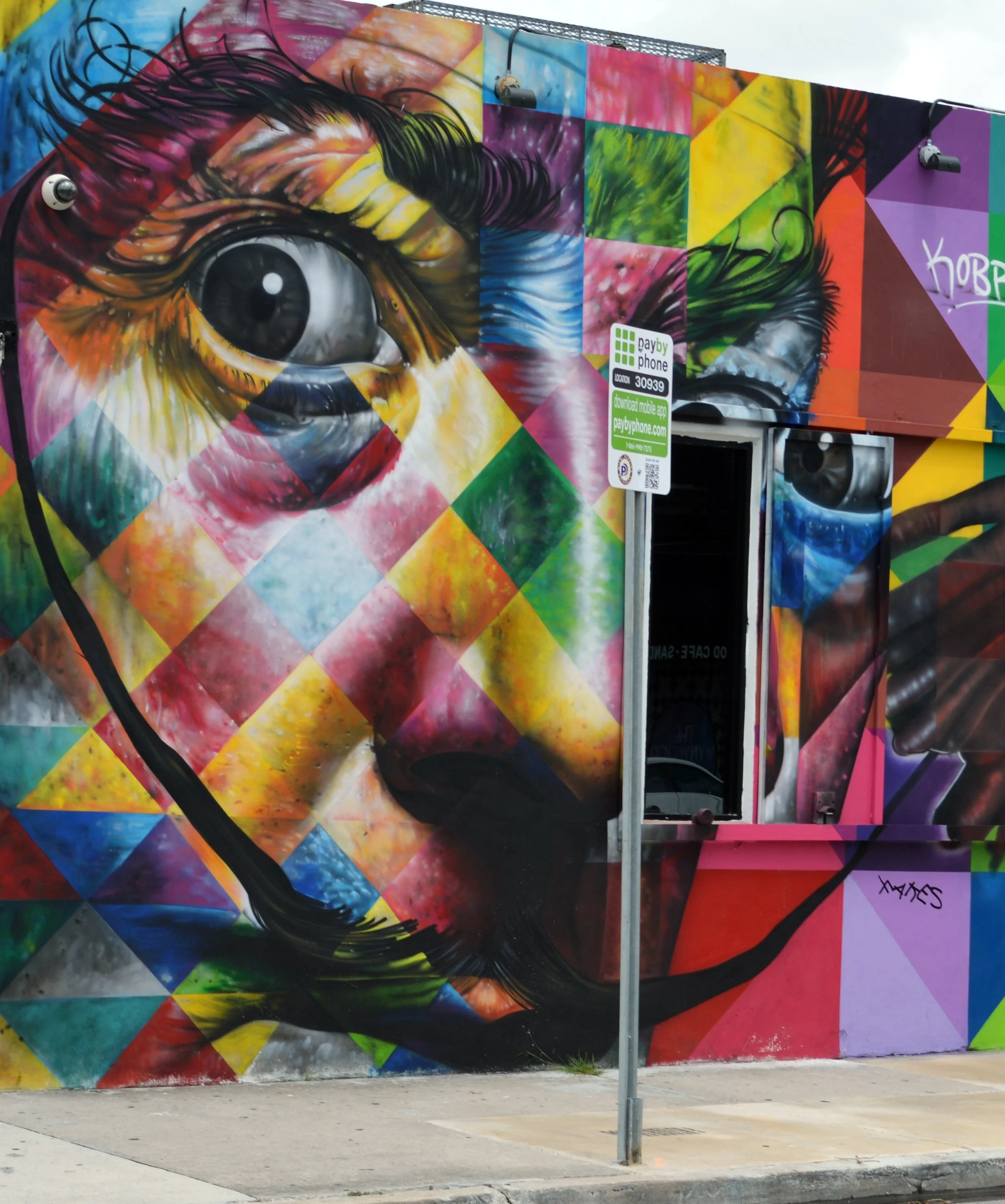
I went to Dalí Cybernetics at Lokomotivværkstedet in Copenhagen in the autumn of 2023. It is a touring show, produced by Layers of Reality and Exhibition Hub and authorised by the Gala-Salvador Dalí Foundation, and it puts you inside projections instead of in front of paintings. Ambient sound, walls and floor moving together, a twenty-minute reel, and at the end a VR headset and fifteen minutes in what the producers call a Dalinian metaverse.
A line from the wall text, attributed to Dalí:
“Man cannot change or escape his time.
The eye sees the present and the future”
It has stayed with me, and it sits close to the centre of what foresight work is for. We are products of a moment we did not choose and cannot step outside. What we can do is look from inside it, deliberately, at what might come next. Perception is the instrument.
What was actually artificial
The show was made by people. Curators Imma Fondevila and Anna Pou worked with the Dalí Foundation's Centre d'Estudis Dalinians. Digital studios built the projections, Rafel Plana wrote the score, and someone designed the VR environment you end up standing in. That is worth stating plainly, because the AI was the part everybody talked about in 2023, mine included. Three years on it might have been the least interesting thing in the building, almost nobody now is impressed that software can produce an image in a dead painter's style.
What has stayed with me had nothing to do with how the pixels were made, it was being inside the thing instead of looking at it.
One small correction while we are here, since the name comes up whenever this exhibition does. OpenAI's DALL·E was named for Dalí and for Pixar's WALL·E, which is the better half of the joke. It made images from text, and it is now retired, deprecated at the end of 2025 and switched off in May 2026. I still remember when the model came out - turns out three years is not long.
Dalí and science
The part of the exhibition that surprised me was how much of Dalí's work came out of reading science.
His nuclear period is the best documented. After Hiroshima he told André Parinaud that the explosion of 6 August 1945 had struck him seismically and that the atom had become his favourite subject. He gave the resulting work a name, nuclear mysticism, and a manifesto in 1951. Leda Atomica, worked out with the mathematician Matila Ghyka. Galatea of the Spheres. Corpus Hypercubus. The Disintegration of the Persistence of Memory. By 1958 he had moved on: "My father today is Dr Heisenberg."
When Watson and Crick published, he answered with a painting whose title fuses Gala, Dalí and deoxyribonucleic acid into one unpronounceable word, and described DNA as long as the genetic persistence of human memory. He subscribed to scientific journals for decades and read them seriously.
He met Freud once, in London in July 1938, arranged by Stefan Zweig. He brought Metamorphosis of Narcissus along and sketched Freud while they talked. Freud's verdict was that in classical painting he looked for the unconscious, and in a surrealist painting for the conscious.
The soft watches are not Einstein, whatever the gallery labels say. Ilya Prigogine asked Dalí directly whether relativity was behind them, and Dalí told him they came from a surrealist perception of a Camembert melting in the sun. I prefer the version where the great emblem of relative time is a cheese.
None of this makes him a scientist. It makes him a thief with excellent taste in sources. He was not illustrating physics or genetics; he was taking whatever he could use and putting it to work somewhere else entirely. Whether machines might one day make art on their own does not seem to have crossed his mind, and it is not a question he needed. He liked new instruments, and he used them: Hitchcock's dream sequence in Spellbound, Destino with Disney, twenty-eight takes of thrown cats with Philippe Halsman.
The part that matters for foresight work
The exhibition affected me far more than a gallery of the same paintings would have. Not because of the technology. Because it put me inside a world instead of describing one to me. If you can do that with a dead surrealist, you can do it with a future.
Most foresight output is a document or a slide deck. Both ask the reader to do the imaginative work themselves, in an office, on a Tuesday, while thinking about something else. A scenario read is a scenario held at arm's length. A scenario inhabited is a different object, and people carry it around for years.
This has a name and a literature. Experiential futures, developed by Stuart Candy and Jake Dunagan out of Candy's 2010 doctoral work at the University of Hawai'i and set out in their essay "The Experiential Turn" and their 2017 paper in Futures. The Experiential Futures Ladder is the working tool, running from abstract to concrete in four rungs:
Setting - the context you are working in.
Scenario - a particular story about that setting.
Situation - the kind and scale of encounter you are staging, from a presentation to a full performance.
Stuff - the artefacts, props, environments and objects that make the situation real.
Most futures work stops at Scenario and hands over a document. The point of the ladder is that it keeps going, and the last two rungs are where an audience stops watching and starts occupying.
The neighbouring practices are worth knowing. Candy and Watson's card game The Thing From The Future has probably brought more people into futures thinking than any report ever written. Guerrilla futures stages interventions in public, for people who never agreed to attend a workshop. Dunne and Raby's Speculative Everything is the design-side canon. And the European Commission's Joint Research Centre runs a speculative design programme, Futures Garden, which is the clearest sign yet that the approach has reached policy.
Against seamlessness
The obvious conclusion from an evening inside a Dalí projection is that immersion wants to be as seamless and beautiful as it can be. I am no longer sure that is right.
Sarah Pink and colleagues published work in 2025 arguing that deliberately broken AI-generated futures often work better than polished ones. When a generated scenario is visibly implausible, people correct it from their own lived experience, and the correcting is where the insight arrives. A seamless immersive future invites you to accept it. A rough one invites you to argue with it, and argument is what you want in the room.
It cuts against everything I found impressive that night. I have kept it for that reason.
Three things I took from Dalí
We are shaped by our moment and can still work on the next one. The wall text was right about the constraint. The answer to being a product of your time is to look from inside it deliberately, and to stop pretending you can stand outside.
Imagination is a practice. Dalí's came from reading physics and genetics and stealing whatever he could use. The machines are not going away and the interesting question is not whether they can imagine. It is what they free us to look at.
Move people into the future instead of describing it to them. This is the one I have actually changed my practice over. If a scenario matters, ask what it would take for someone to stand in it. That is a harder brief than writing a report, and it is the difference between being read and being remembered.
Originally published in 2023. Substantially revised in September 2026.
Sources and further reading
Dalí Cybernetics: The Immersive Experience, produced by Layers of Reality and Exhibition Hub, authorised by the Fundació Gala-Salvador Dalí. Copenhagen at Lokomotivværkstedet, from September 2023
Carme Ruiz, "Salvador Dalí and science: beyond a mere curiosity", Fundació Gala-Salvador Dalí (2010)
Stuart Candy, The Futures of Everyday Life: Politics and the Design of Experiential Scenarios, PhD dissertation, University of Hawai'i at Mānoa (2010)
Stuart Candy and Jake Dunagan, "The Experiential Turn", Human Futures (2016), and "Designing an experiential scenario: The People Who Vanished", Futures 86: 136-153 (2017)
Stuart Candy and Kelly Kornet, "Turning foresight inside out: An introduction to Ethnographic Experiential Futures", Journal of Futures Studies 23(3) (2019)
Anthony Dunne and Fiona Raby, Speculative Everything: Design, Fiction, and Social Dreaming, MIT Press (2013)
Sarah Pink, Hannah Korsmeyer and Ben Lyall, "Generative AI and Broken Futures", Qualitative Inquiry (2025)
Bol, Krzysztofowicz, Mehnert and Rosa, "Futures Garden: Using Speculative Design to Inspire Policy Making", World Futures Review (2025)

Using AI to expand your foresight practice
How do you bring AI into futures work without losing the depth and discipline of good foresight?
AI-augmented foresight is the use of AI tools as a partner in scanning, sensemaking, scenario building and prototyping, with a practitioner still making the judgement calls. AI is changing how we work with futures quickly, and it works far better as a catalyst for creativity and clarity than as a shortcut around the thinking.
In this hands-on and reflective masterclass, foresight experts Mathias Behn Bjørnhof (ANTICIPATE) and Chloé de Ruffray explore where AI becomes a useful partner in futures work and where it gets in the way. You will come away with practical tools and with the do's and don'ts of AI-augmented foresight.
What you will learn
✺ How to use AI as a creative co-pilot in scanning, sensemaking and scenario building, while avoiding hype and traps
✺ Which tools and workflows actually work in a foresight context, from signal generation to speculative prototyping
✺ When to trust, tweak or challenge AI outputs so your foresight work stays strategic, ethical and human-centred
✺ How to build an AI-augmented workflow that fits the way you already practise
Methods and tools covered
✓ AI-assisted horizon scanning and signal generation
✓ AI-supported sensemaking and clustering
✓ AI in scenario building and speculative prototyping
✓ Prompting patterns for foresight work, collected in the Augmenting Foresight Prompt Guide
Who it is for
Foresight professionals, strategists, innovation teams, and curious thinkers ready to expand their craft. No technical background is required.
What you receive
Your purchase is a downloadable zip file containing:
✓ The full 90-minute session video replay
✓ The Augmenting Foresight Prompt Guide
✓ Slides and workbook
✓ Full transcript
Buying for a team or through your company?
If you would like several seats, an invoice, or a purchase made through your organisation rather than by card, fill in our contact form and we will arrange it. We also run this masterclass as a live, tailored session for teams.
By purchasing this digital product, you confirm that you agree to the following statement: "I agree that delivery begins immediately upon payment, and I understand and accept that my 14-day right of withdrawal expires once delivery has begun.”
VAT (25%) is applied according to the EU place of supply rules for digital services. Danish VAT number: DK45996689